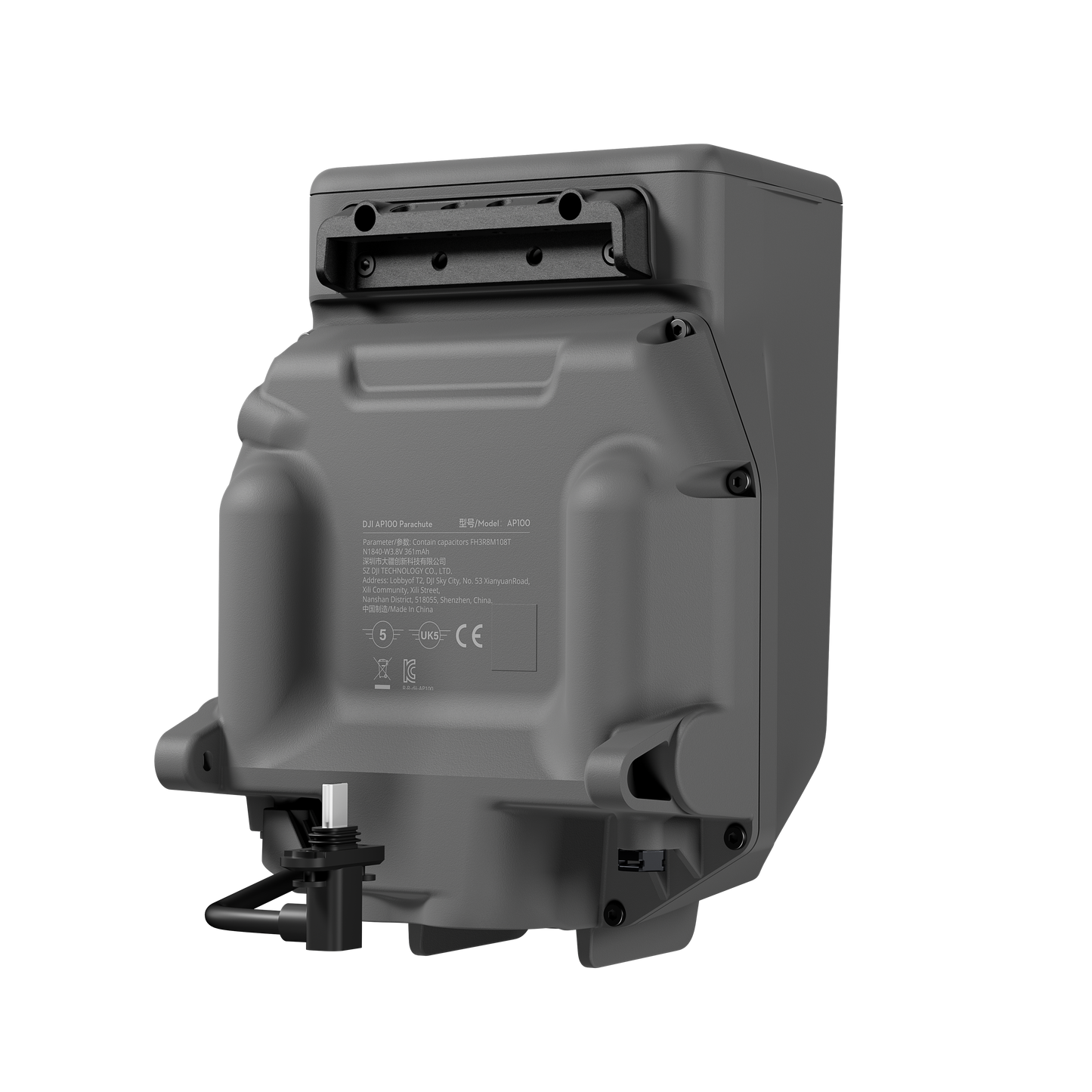


DJI AP100 Parachute
DJI AP100 Parachute
Protect What Matters — Above and Below
The DJI AP100 Parachute is a purpose-built recovery system for the DJI Matrice 400, designed to bring an added layer of safety to high-stakes missions. Whether you're flying over active worksites, near crews, or planning complex BVLOS operations, the AP100 helps protect your platform, your payloads, and the ground below.
Continuous self-monitoring
From power-on through the entire flight, the parachute monitors its own gas generator and communication links. Any anomaly triggers a real-time alert through the Health Management System in DJI Pilot 2. An independent flight controller and IMU sensors let the parachute cross-validate data with the drone continuously, which cuts the risk of accidental deployment.
Independent power
Built-in dual capacitors supply up to an hour of backup power, keeping attitude monitoring and automatic deployment active without depending on the aircraft's main battery or an E-Port connection.
Instant motor cut-off
With a response time under 600 milliseconds and a stabilized descent rate of 5 m/s or less, the AP100 reacts faster than any pilot can. It supports both automatic deployment triggered by the aircraft and manual deployment by the operator, with an independent power supply and full-link redundancy so the system stays armed even if the aircraft loses power.
Audio and visual alarms
After deployment, the system sounds alarms and flashes high-intensity lights for about an hour — clearing the area on the ground and helping operators locate and recover the aircraft.
Deployment methods
- Automatic, on detected attitude or speed anomalies.
- Automatic, on a Geocaging boundary breach set in DJI Pilot 2 (EU, UK, and other supported regions).
- Manual, via the on-screen slider in DJI Pilot 2.
- Remote, via DJI FlightHub 2's Flight Termination System page, using the aircraft serial number and a verification code (requires a DJI Cellular Dongle 2 and 4G connection; EU, UK, and other supported regions).
Built for Real-World Conditions
IP55-rated and rated for operation from -20°C to 50°C, the AP100 is ready for Canadian winters and summer heat alike, at altitudes up to 4,500 m. At roughly 935 g including the mounting bracket, it supports the Matrice 400 up to its full 15.8 kg maximum takeoff weight — no need to sacrifice payload capacity for safety.
Certified Safety Pedigree
When paired with the Matrice 400, the AP100 meets EASA C5/C6 and UK CAA UK5/UK6 operational safety requirements — the European standards governing flights over populated areas and BVLOS operations. For Canadian operators, that same engineering translates directly into stronger safety cases for advanced operations, risk mitigation over people, and insurance and client requirements.
One trade-off to plan for
Fitting the AP100 automatically disables the M400's downward and backward mmWave radars, reducing obstacle sensing in those directions. It's a deliberate design decision, but one worth building into your operational planning.
Single-use safety device
Like all parachute recovery systems, the AP100 is single-use — once deployed, it needs replacing before the next flight. DJI recommends retiring and replacing a unit three years after activation regardless of self-check results.
Use cases
- Urban patrol (M400 + AP100 + H30T + Spotlight + Speaker): Broadcast traffic guidance or event safety notices, with fewer safety-driven mission limits in dense urban areas.
- Facade cleaning (M400 + AP100 + cleaning equipment): Fly close to glass curtain walls with a safety chain that reduces risk to buildings and the ground — often a condition for the work permit itself.
- Delivery (M400 + AP100 + delivery box): Lab-to-hospital transport, remote and island delivery, and time-critical parcels, backed by a fail-safe for urban airspace operations.
Specification
| Spec | Value |
|---|---|
| Compatibility | DJI Matrice 400 |
| Dimensions (with bracket) | 182 × 171 × 157 mm (L×W×H) |
| Weight (with bracket) | Approx. 935 g |
| Max supported takeoff weight | 15.8 kg |
| Deployment response time | < 600 ms |
| Stabilized descent rate | ≤ 5 m/s |
| Minimum effective deployment altitude | ≥ 30 m |
| Deployment modes | Automatic + manual |
| Power | Independent power supply, full-link redundancy |
| Ingress protection | IP55 |
| Operating temperature | -20°C to 50°C |
| Operating altitude | 0–4500 m |
In stock
View full details